Friday, September 23, 2005
Injustice at Catholic Seminaries
As the Catholic Church begins to take a deeper look at their seminaries many homosexual priests are upset. The Roman Church is seeking to weed out all homosexuality and homosexual practice within the priesthood. In light of the recent sexual abuse scandals that have riddled the church many argue that such a move will cut off the problem at its root. However, as expected, most homosexuals are not at all happy.
It appears that the Vatican is working on a document which will bar all gay men from the clergy. They will begin at the seminary level in hopes of rooting out any homosexuals which may be thinking they are called into the ministry.
One 48 year old gay priest has compared the recent moves of the Roman Church to Hitler’s “Final Solution” by exterminating and persecuting all the Jews. A 30 year old Franciscan seminarian says that the thought of leaving seminary has not crossed his mind and that he desires to speak out against such “injustices.” Others argue that homosexuality is not the issue, but celibacy is. Msgr. Denis Herron, pastor of St. Teresa's Church in NY, believes that a commitment to celibacy is more important than one’s sexual orientation. "Some people can't make that commitment, and that can be heterosexuals or homosexuals," Monsignor Herron said. "I'm concerned that this could turn into a witch hunt."
It very well may turn into a witch hunt but are not some witch hunts necessary? The Bible is clear in its denunciation of homosexuality. The question then becomes, “how closely will the Roman Catholic Church follow the teachings of the Bible?” This issue is much deeper than just a few sexual abuse scandals – it is a matter of God’s holy word.
Read a TIME article on the Roman Church and Homosexuality.
UPDATE: Amy Welborn, in an Op Ed for the NY Times, argues for the validity of such a "purge" of homosexuality from Catholic seminaries for the sake of the people in the pew. She writes, "But a seminary also owes us, the people in the pews, psychologically mature priests who aren't engaged in an eternal and ego-driven struggle with their own problems, who are prepared to serve, to teach and preach - with integrity and honesty."


Sunday, September 18, 2005
Bridging the Chasm: Abstract to Concrete
Trying to teach abstract ideas to concrete thinkers is tantamount to trying to explain the difference between red and orange to a person who was born blind. How would you seek to explain grace, mercy, redemption, or righteousness to concrete thinkers without at the same time teaching something that is not really accurate?
Bridging the Chasm: Abstract to Concrete
In order to bridge the chasm of abstraction for those who think concretely the use of examples may prove the best. Concrete thinkers need to see and hear concrete examples. Examples, however, can only exist on an analogical relationship between that which they attempt to represent. For instance, an example of grace can only mirror the reality of grace. As an example it may have some dissimilarity between the reality of grace in abstraction. Yet, even though this analogous relationship exists I do believe that is exactly the method Scripture uses. The Bible does not discuss grace, mercy, redemption, and righteousness in abstraction. Instead the Bible uses concrete examples from life and history.
First, there is grace and mercy. Grace (or mercy) in abstraction may be defined as receiving that which we do not deserve. Yet, grace is made real and concrete when sinners who deserve death and judgment actually receive grace and mercy. Romans 5:8 best exemplifies the concrete example of grace: “but God shows his love for us in that while we were still sinners, Christ died for us.” The concrete reality of the death and resurrection of Christ display the grace and mercy of God.
Secondly, there is redemption (or ransom). Abstractly it may be defined as being saved from something evil or bad. Yet, here again, we see that the example of Christ brings home the abstraction of redemption. Scripture uses a variety of metaphors and examples to explain redemption. First, there is the idea that we are dead in trespasses and sins, yet we are made alive in Christ (Eph. 2:1; Rom. 6:11). The Devil has captured humanity and is the king of the earth, yet Christ came in order to destroy the works of the devil and to ransom those who were once children of darkness (1 John 3:8-10). And of course, probably the most prominent event in the Bible is that of the Exodus. The Exodus is the paradigmatic story of redemption and ransom from out of slavery and bondage. This event serves as a type of the redemption found in Christ.
Lastly, there is the idea of righteousness. This concept in abstraction may be defined as holy and moral perfection. This is even a more difficult concept to explain concretely because the examples are hard to come by – for there are none righteous (Rom. 3:10). The examples of the cult rituals of OT Israel which prefigured Christ may serve as a helpful example differentiating between righteousness and unrighteousness. It is probably true that unrighteousness is easier to explain than righteousness – there are more examples and illustrations to use!
The Bible is full of examples and illustrations to help bridge the gap between abstract thought and concrete thought. As a side not this is why chronological Bible-telling is so effective and helpful in more orally traditional cultures (non-western cultures).
Thursday, September 15, 2005
Lakeshore Baptist Church
Lakeshore Baptist Church was decimated by Katrina. Yet, in the midst of hopeful tears they continue to worship together. All but one of the members homes was destroyed and as Pastor Elbourne describes, they are a church in exile. The pictures are amazing...
Tuesday, September 13, 2005
Total Depravity in the News
More verification that our world is lost in sin and misery.
Two men were convicted of murdering a transgendered person. After they discovered that Gwen Araujo used to be a boy they killed him/her.
A Haitian woman recounts her rape and beatings at the hand of the Haitian paramilitary.
Eleven children were found caged in Ohio.
Nursing home owners are charged with multiple deaths and negligence in the wake of Hurrican Katrina.
Monday, September 12, 2005
Comment Spam
I don't really want to do this but my hand has been forced. I have turned on a word-verification form for the comments to help eliminate comment spam. Every time I post something it gets spammed. Just type in the words shown and you will be allowed to post your comment - sorry for this inconvenience, but it should help keep things clean.
Evangelism and the Devotional Life
How does evangelism and devotion to Christ fit together? What affect does our time spent in prayer and the Word of God have on our evangelism? There have generally been two responses to this question and with these responses therein lies two dangers. First, there is the danger of seeing ones devotional life as a causal event which produces the effect of evangelism. This view argues somewhat as follows: I just had a great time with the Lord, therefore I am ready to share my faith with anyone. On the corollary it also argues that if you have a devotional time and get nothing out of it or if you skip your devotions then you are unfit to accomplish any fruitful evangelism. This is the error of legalism. The Church has been swept away by the flood waters of such thinking, washing away the true hope and motivation for evangelism.
The second error is to think that no devotional life is needed for evangelism. We can just go out and do it without any spiritual preparation. This views sees no conditions whatsoever on the Christian and his purposes in the world. This is the subtle error of antinomianism. It is a rejection of God’s law and the way he intended for his people to obey him.
Both legalism and antinomianism are guilty of separating one’s time of devotion away from the rest of one’s life. It is the fallacy of compartmentalization. Legalism argues that a set aside time of devotion to Christ insures a good or at least faithful witness. Antinomianism teaches that such a time of devotion is unnecessary to the task which God has called us unto. Both are affronts to the gospel of Christ and Biblical evangelism.
God’s blessing of our evangelism is not dependent on our performance. We have a gospel centered salvation but a performance focused sanctification. This is not the Christian life, but a life lived under the shackles of legalism or antinomianism. The true Christian life is one that teaches that we are saved by grace and that we are to live daily by that grace.
Jerry Bridges attacks our sinful thinking of “good days” vs. “bad days.”[1] On a bad day spiritually we see ourselves as too sinful and worthless to evangelize. We skipped our devotions or got nothing out of them. It was a dry time and because of this we think that we are unspiritual, unfit to evangelize. Then on good days we had a time of sweet fellowship with Christ and feel that nothing could stop us. We are hopeful in our evangelism and believe that because of our being filled up with the Spirit our witness will be effective.
Every day, our good and bad days “should be a day of relating to God on the basis of his grace alone.” Bridges offers up this earth shattering spiritual principle: “Your worst days are never so bad that you are beyond the reach of God’s grace. And your best days are never so good that you are beyond the need of God’s grace.”[2] Even our good works of evangelism are filthy rags in need of cleansing through the blood of Christ. We must take our eyes off of our performance and place it on our Savior. Our filthy rags are to no avail, but Christ and his perfect righteousness imputed to sinners such as ourselves is the hope of the gospel for all of life.
Yet, there is also the danger of forsaking our duty to evangelize because the gospel covers all of our sin. “What shall we say, then? Shall we go on sinning so that grace may increase? By no means! We died to sin; how can we live in it any longer?” (Romans 6:1-2). We are no longer compelled to evangelize by our guilt, we are to be motivated by the love of Christ. “For Christ's love compels us, because we are convinced that one died for all, and therefore all died” (2 Cor. 5:14). Our devotional life and our evangelism must be motivated by love to Christ and not guilt for our countless sins and endless shortcomings.
Here we see the necessity of a life of devotion to Christ for the purpose of effective Biblical evangelism.[3] It is the gospel which motivates our hearts to share the love of Christ with others. Without spending time in the Word and in prayer we will not be reminded of his love and we will fail to be compelled to share it with others. We need the gospel every hour, every day of our lives.
There is also a danger of seeing our devotions as limited to a set aside time to worship Christ, read the Word and pray to our Father in heaven. I am not advocating that we abandon a set aside time of devotion to Christ, but that we so reorganize our lives that we see not a set aside 15 minutes as our devotional time, but the very entirety of our lives as a living sacrifice of devotion to Christ. It is not our time of devotions, but our life of devotion which counts in the long run.[4] We are to do all things to the glory of our God, our creator and king.
[1] Jerry Bridges, The Disciplines of Grace: God’s Role and Our Role in the Pursuit of Holiness (Colorado Springs, CO: NavPress, 1994), 15-17.
[2] Ibid, 18, emphasis his.
[3] By using the word “effective” I am not referring to the amount of conversions or baptisms but evangelism carried out purposefully for the proclamation of the Word and the glory of Christ.
[4] Of course, it must not be forgotten that a life of devotion to Christ presupposes a consistent time spent in the Word and in prayer.
Sunday, September 11, 2005
Islam and Peace
We have heard in the Western media that Islam means peace. Therefore it has been deduced that Islam is a peaceful religion which has been hijacked by a few radicalists. While a derivative of the word "Islam" does mean peace the central meaning of Islam actually means submission. Islam is a religion of submission of the whole person to Allah.
In a video tape released today, 9/11, a Muslim threatening Los Angeles and Melbourne, Australia says the following: "We are Muslims. We love peace, but peace on our terms, peace as laid down by Islam, not the so-called peace of occupiers and dictators."
The Islamic notion of peace is submission of all to Islam. At least this is what the so-called "radicalists" are saying...
Operation World
For many years Patrick Johnstone has produced Operation World. Simply, it is a prayer guide for the nations. It details the nations of the world for the purpose of informing the reader to better pray for those peoples. It looks at the religion, geography, economy, politics, and culture of any given people. Then after the “facts” are given there are numerous suggestions for prayer and outreach. It is simply an amazing resource. There is even a CD and a website.
I have my homepage set to Operation World’s Pray Today. This page defaults to the nation scheduled to pray on that specific day. I would encourage you to set this as your homepage and be reminded to pray for the nations every time you log onto the internet. That all the nations of the earth will one day praise his name!
Saturday, September 10, 2005
Tensions of Turkish Identity
In one of today's New York Times editorials, the case of Orhan Pamuk - a novelist charged with the “public denigration” of Turkish society - stands to remind us of the underlining tensions of Turkish identity. Pamuk, facing up to three years in Turkish prison, has left the country. Indeed, I would say that there is a multifaceted tension of identity. There are at least three vying for attention: Islamic, secular, and nationalistic.
The Islamic consciousness of Turkey longs for a strong Muslim presence and rule in the country. While, the Turkey is considered about 99% Muslim, the majority of those “Muslims” live as secularists even if they profess Islam. An Islamic identity would bring a resurgence of Islam to the table including the stronger more radical forms of Islam. This is a direct tension which would severely limit their options for joining the European Union.
Then there is the secular consciousness of Turkey which I would say is the predominate view. This is the thought and lifestyle of those in the major cities and outlying areas. The impact of the West cannot be denied on this Islamic country. Its presence is everywhere, from cell-phones to McDonalds. This Western influence is what is allowing the EU to remain partially open to Turkish membership.
Then there is the strong undercurrent of nationalistic consciousness. This identity can actually cut across and flow through the other two yet also remains separated. Those who strongly identify with Mustafa Kemal, the founder of the Turkish Republic, are the military and leaders of the present Turkish government. They fear the EU for what it could do to undermine the country’s Kemalist ideals. Yet, they also fear the Islamic identity for Kemal wanted a more Westernized society and almost paradoxically they fear the western secularist identity as too strong of a break from the past.
Turkey is a land in tension. A country that exists between two worlds: the West and the Middle East, secularism and Islam. The next few years are defining for Turkey. If they are able to join the EU I believe a change of openness and democratic secularism will gradually influence the country, yet if they are denied membership than I believe that the option of Islamic rule will gain a stronger foothold in the country. A resolution of this tension will either strengthen Turkey or begin to erode the country. For now we can only wait and see what will happen along with Mr. Pamuk.
Sunday, September 04, 2005
Gospel Motivation
Here is my answer to two questions I was asked for a class on personal evangelism.
1) What motivates you to witness
2) The most significant "barrier" to witnessing with which you struggle
For better or for worse there is a difference between what often motivates me and what should motivate me to witness. For instance, in this course we are required to witness and share the gospel at least seven times. So, in this particular case the primary motivation may overwhelmingly be the course requirement. Of course, this is a wrong motivation but given that it is a requirement it is an unavoidable one. On the other hand, though it cannot be completely dismissed as wrong. Maybe someone, like me, needs the requirement of a course to motivate into active evangelism. It may first be as a duty, but through actively performing evangelism and seeing the power of God and his gospel the work of evangelism will (I hope and pray) turn into a delight.
Now what should be the true and proper motivation toward Christian proclamation? The Gospel. It is the love of Christ displayed to poor and wretched sinners which should motivate us to share this love. Only once we have understood that we as poor, miserable, and destitute sinners have been redeemed by the blood of the lamb, only then will we be constrained to proclaim the glories of Christ. We need to let Romans 5:8 sink in to our hearts and minds: “But God demonstrates his own love for us in this: While we were still sinners, Christ died for us.”
I believe that the greatest barrier to my consistent evangelism is the failure to recognize and fully grasp the motivation of evangelism. When I forget the gospel or when the gospel is not impacting my life then I loose the sense of urgency and importance for evangelism. Yet, if the gospel is revived and if I begin to live the gospel then a naturally out flowing of my gospel life will be a desire to share it. When one forgets the grace and mercy of God to miserable sinners one doesn’t see the need of sharing what is not important or what hasn’t impacted their life. Yet, when the reality of the gospel burns within our hearts we will have no other choice to share. Therefore, a recover of the undiluted, pure gospel of Jesus Christ is necessary to achieving consistent and faithful biblical evangelism.
Thursday, September 01, 2005
Ambassadors for Christ
Little, Paul E., How to Give Away Your Faith. Downers Groves, IL: InterVarsity Press, 1966, 1989. 191 pages.
Introduction
Paul Little’s classic work, How to Give Away Your Faith, offers a simple yet often times profound look at one of the “hardest” tasks of the Christian life: evangelism. Witnessing is hard. Most Christians try to stay away from it and those who do evangelize often prove to be more of an embarrassment to the faith than a witness. How are we to faithfully proclaim the gospel of Christ to a world in need? How do broken clay jars carry an eternal message of hope and life to the thirsty and starving? In seeking to answer such questions, Little charts a helpful course for those who seek to be Christ’s ambassadors to the world.
Summary
Be Real! The world’s need for Christ is real and his help is a necessity. Christ and Christianity are the only real answers to the world’s need. We must be aware of this need and we must sincerely and truthfully proclaim the wonders of his name. It is our duty to live a life of genuine faith and sincerity of mission because superficial Christianity is empty and meaningless. Our focus should be ultimately placed on things eternal while seeking to remedy things material. Our goal is to have others not just assent to the facts of Christianity but to believe in the Christ of Christianity.
How then are we to witness? First, Little highlights the necessity of evangelism for our own personal spiritual growth. It is necessary to witness the power of the gospel. Then we must obey. Evangelism is a matter of obedience. Obedience to Christ brings forth proclamation of his truth. Little proceeds to list seven steps toward active evangelism. First, we must have contact with others in a social context. Secondly, we must seek to establish a common interest with the purpose of bridging communication. Then we must provoke an interest in spiritual things. Fourthly, we must recognize when we should stop and when we should continue on sharing. We also must not condemn those whom we are witnessing too for their various sins. Sixthly, we must not become sidetracked. We must stick to the main message. Lastly, we must call them to repentance. We must call them to believe in the Lord Jesus Christ that they might be saved.
How do we handle those “ticklish” awkward situations? Our desire is to have the unbelievers with whom we are in contact to begin to respect us even though we are different. As they begin to respect us so they will also begin to listen to us instead of viewing us as weird or insane. But awkward moments will come and the best thing we can do is to be prepared for them. We should anticipate difficult situations and have alternatives to comfortably work through them.
As ambassadors of Christ it is our duty to proclaim his message. The messenger must know and understand the message for the purpose of being a faithful and knowledgeable ambassador. Little sums up the gospel message in Jesus Christ himself – “who He is, what He has done, and how He can be known in personal experience” (56). He suggests following the pattern of problem, diagnosis, cure for setting forth the message of the gospel.
Further, ambassadors cannot just know the message but they must also believe it and live it. We don’t have all the answers, but we nonetheless must be ready to give a reason for the hope within us. There are many questions, which non-believers have, but their basic problem is one of moral unbelief. They have rejected their creator and traded his truth in for a lie.
Christ is the answer to those questions, which are asked. However, he has left it as our duty to show the helpless and lost the importance and relevance of Christ in answering those questions. Christianity is true because Jesus is the truth. He is the relevant truth the world needs.
So how are Christians to witness to a corrupted world without compromising our holiness? It is our duty to reach out to the world, but we must not succumb to worldliness. We must recognize that all of our life is God’s and we are to live as unto him and for his purposes. We should live all of life cognizant of being stewards of God’s time and we must strive to live a life of constant witness to the truth.
The gospel is not just for a one-time salvation event; the gospel is for life. Faith in Christ, the object of our salvation, must continue throughout the Christian life. We are in a daily battle but with Christ it is a victorious battle. We battle against our secret self; against sins both external and internal. This battle must be fought with the Sword of the Spirit and it must be waged through the power of prayer. We also battle over time and priorities, which must be aligned with God’s prerogative. In doing so we will have fought a victorious battle.
Evaluation
It is hard to summarize the gospel. It encompasses the totality of the person and work of Christ. It cannot be easily reduced; yet, all gospel presentations in one-way or another do so. Little summed the message of the gospel up briefly in five points (or three facts: problem, diagnosis, cure). The gospel by no means is limited to these five points or four spiritual laws. Because the gospel is the message and motivation for evangelism it would have been helpful to spend more time on explicating the basics of the gospel message. He does offer good suggestions in helping us better understand the gospel: write it out, tell other Christians, tell non-Christians.
I began reading Little’s “Seven Basic Questions” which non-Christians ask with the thought of seeing how postmodernism has changed those questions (67-81). Surprisingly, many of the questions being asked back in the 60’s and 70’s are the same ones being asked in the 21st Century. The destiny of the lost, the exclusivity of Christ, the problem of evil, miracles, and the veracity of the Bible are all questions still being pondered today. However, one will have to look elsewhere to find more comprehensive answers to these questions.
Chapters 7-9 seem a little disconnected from the whole of the work. While they do relate in many ways to evangelism they don’t seem to relate as much as previous chapters. They do relate, but it seems that Little could have done a better job in integrating them together into a coherent whole. These later chapters seem to move away from teaching about evangelism toward various basics of the Christian life. It probably would have proven more helpful to have those chapters under a heading of what to do after evangelism. Maybe it would have been more worthwhile to have those chapters in the beginning to discuss the character and duties of the evangelist.
Another factor which Little did not really deal with was the role of Scripture memorization in evangelism. Maybe this would fall under a general knowledge of God’s Word, but it seems important enough to warrant a separate discussion. The one who has hide God’s Word in their heart will have a great arsenal at their disposal when it comes to the battle of witnessing. Being able to go to the Bible will help show the non-Christian the importance to Scripture and that it contains the hope for this life and the next.
Conclusion
Witnessing is not optional for the Christian. In fact, as Little has shown, it is vital to the Christian life. It is a matter of obedience to our Creator and Redeemer. Little, offers a helpful guide toward developing better witnesses. While he offers various witnessing helps he goes beyond the task of evangelism and hits the witness himself. This is where Little is most valuable and while this work will be used for some years to come.
To be a Turk...
...is to be a Muslim. This is the philosophy of the majority of the Turkish people. A true Turk cannot be a Christian. Because of this the persecution continues.
Saturday, August 27, 2005
Scriptural Lenses for Cultural Viewing
Note: The following post is my rambling of an answer to the question below. It is for a class I am taking called Intercultural Communication.
God's Word is the only concrete absolute in our universe; it informs all cultures and can be changed by none. We should be biblical absolutists. Yet, we should always strive toward being cultural relativists. How? Why? Can something be right in one culture and wrong in another? Is there a purely Christian culture in the world today that all others should seek to imitate?
Scriptural Lenses for Cultural Viewing
Here is the obvious: cultures are different and varying, but Scripture is unchanging and perfect. Scripture then is to be the glasses which culture is viewed through. In order to determine right and wrong within any given culture we must go to the word of God. The Bible is to be the light upon our path as we walk along the diversity of today’s cultures.
Yet, somewhat ironically, the Bible is never alone. We interpret Scripture and because we exist in a specific context our interpretations will be tainted by that context. This is not a denial of Sola Scriptura but an affirmation of our (and the Bible’s) historical situated-ness. We do not exist in a vacuum and we must also affirm that Scripture was written in history. Indeed, even the Word made flesh was born into history, born into a specific cultural context. Galatians 4:4-5 “But when the time had fully come, God sent his Son, born of a woman, born under law, to redeem those under law, that we might receive the full rights of sons.”
Are we trapped then, drowning in the pit of postmodern relativistic despair? By no means! Let’s rehash first: Scripture is to inform and stand over culture, yet inescapably culture informs and helps define our understanding of Scripture. Thankfully, we are not left doing hermeneutical donuts in the snowy mix of postmodern flakiness.
I believe Grant Osborne has offered an immensely helpful way out. Instead of the never-ending hermeneutical circle, Osborne argues for a model, which he calls, The Hermeneutical Spiral. Given this approach you are able to move from text to context (culture in our case). A spiral is a better metaphor than a circle, “because it is not a closed circle but rather an open-ended movement from the horizon of the text to the horizon of the reader” (Osborne, 6). There is marked progress. He continues:
I am not going round and round a closed circle that can never detect the true meaning but am spiraling nearer and nearer to the text’s intending meaning as I refine my hypotheses and allow the text to continue to challenge and correct those alternative interpretations, then to guide my delineation of its significance for my situation today.
So why is this important for understanding the relationship of culture to Scripture? Culture and Scripture exist in a symbiotic relationship each informing and interpreting the other. Scripture interprets culture and we are able to view the cultural worldview through scriptural lenses. Likewise, our culture helps us understand Scripture. As Scripture and culture interplay off of each other they do not go back and forth in a circle, but both of them spiral together toward the truth of Scripture’s intended meaning and its specific cultural application. The more Scripture and culture mesh together the closer to the truth they will come in applying Scripture to culture. After all, theology is just simply “applying scripture to life” (John Frame).
Thinking about the incarnation is helpful in providing a deeper-rooted understanding of culture in relation to Scripture. Here, at the point of the incarnation, the Word and culture met. Christ, in taking human form, entered into our cultural-historical context. He did not just assume the body of a man, but entered and became involved within culture. Christ, the Lord of the universe partook in many aspects of the culture at that time (washing of feet, feasting at weddings, reading and debate in the synagogues, etc.). He even died through a means of cultural torture and death. At that time it was a cultural means of death for a crucifixion to be carried out. Yet, he also stood out against culture. He condemned many practices of the Pharisees, which conflicted against Scripture. He even talked with a Samaritan woman. He dined with tax collectors and sinners. For Christ, the foundation and lens of viewing culture is the Word of God. In using the language of Grunlan and Mayers, it is in Christ where "Biblical Absolutism" and "Cultural Relativism" meet.
Friday, August 26, 2005
De-evolution at London Zoo
Human beings are on display at the London Zoo. The sign on their cage reads, "Warning: Humans in their Natural Environment." Yes, they are in a cage and apparently wearing little clothing.
So, just why did the London Zoo put three men and five women on exhibit? Polly Willis, the spokeswoman for the Zoo said, "Seeing people in a different environment, among other animals ... teaches members of the public that the human is just another primate." One of the participants, 26-year-old Tom Mahoney is quoted as saying, "A lot of people think humans are above other animals. When they see humans as animals, here, it kind of reminds us that we're not that special." Mahoney and the seven other “primates” are being treated just like the other animals complete with keepers, but they are allowed to go home at night.
While attempting to emphasis the evolutionary worldview the Zoo actually (unwittingly) is left arguing for a form of de-evolution. In hoping to tie humanity back to the apes they end up, for the sake of argument, reversing the evolutionary growth of humanity. Humanity is returning to the apes.
Well, I have to admit that there is some merit to their evolutionary thinking here. Sinful men and women who reject their creator and sustainer actually become so corrupted that the image of God, which they were stamped with, becomes more and more defiled. Those caged beasts are trading the truth of God for a lie.
Here the sane words of Scripture:
Psalm 8:4-9 What is man that you are mindful of him, the son of man that you care for him? You made him a little lower than the heavenly beings and crowned him with glory and honor. You made him ruler over the works of your hands; you put everything under his feet: all flocks and herds, and the beasts of the field, the birds of the air, and the fish of the sea, all that swim the paths of the seas. O LORD, our Lord, how majestic is your name in all the earth!
Romans 1:20-23 For since the creation of the world God's invisible qualities-- his eternal power and divine nature-- have been clearly seen, being understood from what has been made, so that men are without excuse. For although they knew God, they neither glorified him as God nor gave thanks to him, but their thinking became futile and their foolish hearts were darkened. Although they claimed to be wise, they became fools and exchanged the glory of the immortal God for images made to look like mortal man and birds and animals and reptiles.
With darkened hearts, God has given them over to every form of corruption and defilement. Sinful humanity has de-evolved from the place God intended. Now we are left only a little higher than the apes.
Wednesday, August 24, 2005
Killing in the Name of Science
In The Journal of the American Medical Association (JAMA) a team of doctors has argued that babies (fetuses as they call them) probably do not experience pain until at least the 29th week of gestation. The paper argues that the nerve connections in the brain are not complete enough until that time in order to feel and experience pain. Well here are some of my scattered thoughts based on the New York Times article.
On the JAMA website it is stated that the context for this research is due to the federal legislation that would require doctors to tell woman that after 20 weeks the baby will feel pain and they will recommend anesthesia for the child. The doctors wanted to determine what developmental age a child actual began to feel pain.
The research itself is very sketchy. They used as a basis for their research other writings, whether journals or various medical reports of child pain and the like. So they are basing their conclusions solely on what others wrote? Let’s face it – they are “writing” for the choir. Pro-abortion doctors arguing (seeking) for legitimacy to their taking of unborn life. I guess abortion doctors have to provide job security as well.
Dr. David A. Grimes, a former head of abortion surveillance at the Centers for Disease Control and Prevention, had a help admission to this debate. He said, "This is an unknowable question." Dr. Grimes still performs abortions in North Carolina but he is content to say, "All we can do in medicine is to infer." So inference is their best hope for children not feeling pain. I have to wonder in the back of my mind if this research is performed for the purpose of alleviating the guilt, which doctors and nurses must experience after taking active roles in the murder of unborn children.
Dr. Mark A. Rosen, an author of the journal article and chief of obstetric anesthesia at the University of California, said that we should base our decisions upon “evidence, scientific evidence, not our emotional beliefs." He believes that the evidence points to no pain in unborn children up to the 29th week of pregnancy. Part of the problem is that whenever you raise any objection to such inhumane practice you will simply be dismissed as arguing from emotion and not the facts. This fails to realize two things: First, facts are interpreted. The question then becomes what interpretive framework are you working from? Are you a secular naturalist who sees humanity as simply an evolutionary primate or are you a Biblical Christian who sees all human life created and shaped in the image of God? This matters in understanding the facts. Facts can often go both ways, and they do. Secondly, is it always wrong to argue from emotions? I don’t think so. Emotions are an integral part of our life. They cannot be separated from reason so easily as scientists seem to think.
Dr. K. S. Anand, a pediatrician at the University of Arkansas for Medical Sciences, offered the most sage advice even though he is not against abortions. He said, "In the first trimester there is very likely no pain perception. By the second trimester, all bets are off and I would argue that in the absence of absolute proof we should give the fetus the benefit of the doubt if we are going to call ourselves compassionate and humane physicians." What a great concept – giving children the benefit of the doubt. But if this were to take place then abortion would be illegal. There are just too many questions to have absolute certainty. Therefore if we were to give the benefit of the doubt then abortion would be over.
Even Dr. Rosen, one of the articles authors, admitted that we couldn’t know 100% whether the child does or does not experience pain. Well then, if this is so should we not give the unborn children the benefit of the doubt? Wouldn’t this be compassionate medicine? This surely is the more humane road.
Another thing that I just don’t get is this – why give a child who is about to be brutally murdered anesthesia? I guess this is the humane and compassionate way to commit murder.
Sadly, abortion is not going away any time soon. In America alone 1.3 million lives every year are snuffed out before they even come out of the womb.
My initial reaction is that God would send his quick and swift judgment upon abortion practitioners. However, the more I thought about it the more I realize that they are desperately in need of God’s grace. While God would be glorified whether he sent out judgment or salvation it would nonetheless bring great glory to him to bring many abortion doctors and nurses to Christ. Imagine doctors who once committed abortions now decrying the practice and arguing from a Christian perspective against abortion. We certainly can and must pray for this end.
UPDATE: Derek Thomas and the Guys at Reformation 21 will be blogging about this from a theological and pastoral point of view all next week. You will definitely want to see what they have to say regardless of what side of the debate you fall down on.
Monday, August 22, 2005
In the Cause of Freedom
Today I realized that I do not pray for and thank enough those men and women who fight for the cause of freedom throughout the world. Hundreds of thousands of young men and women have died for our country in this century alone. I remain way to forgetful of their sacrifice. As a small token of my thankfulness to those who now serve our country I quote the following, which is just as applicable today as it was nearly 230 years ago. Thanks to them I remain a free man.
Your exertions in the cause of freedom, guided by wisdom and animated by zeal and courage, have gained you the love and confidence of your grateful countrymen; and they look to you, who are experienced veterans, and trust that you will still be the guardians of America. As I have the honor to be an American, and one among the free millions, who are defended by your valor, I would pay the tribute of thanks, and express my gratitude while I solicit you to continue in your present honorable and important station. I doubt not America will always find enough of her sons ready to flock to her standard, and support her freedom; but experience proves that experienced soldiers are more capable of performing the duties of the camp, and better qualified to face the enemy, than others; and therefore every friend of America will be desirous that most of the gentlemen who compose the present army may continue in the service of their country until “Liberty, Peace, and Safety” are established. Although your private concerns may call for your assistance at home, yet the voice of your country is still louder, and it is painful to heroic minds to quit the field when liberty calls, and the voice of injured millions cries “To arms! To arms!” Never was a cause more important or glorious than that which you are engaged in; not only your wives, your children, and distant posterity, but humanity at large, the world of mankind, are interested in it; for if tyranny should prevail in this great country, we may expect liberty will expire throughout the world. Therefore, more human glory and happiness may depend upon your exertions than every yet depended upon any of the sons of men. He that is a soldier in defense of such a cause, needs no title; his post is a post of honor, and although not an emperor, yet he shall wear a crown – of glory – and blessed will be his memory!
Excerpt taken from the New England Chronicle, signed simply “A Freeman.” Winter, 1776. Quoted in David, McCullough, 1776. New York: Simon & Schuster, 2005; pp. 62-63.
Thursday, August 18, 2005
United Way and the Gospel
In work today we had the mandatory United Way meeting. All the big companies have them. When I worked at UPS we had to go and now while at Target. They say it is their way about caring for the community. It sounds like a lot of PR to me.
In those meetings you watch a stirring video, replete with needy children, which lets you know what an impact you can make on your own community. It is very simply an emotional appeal. And it often works. Many people sign up to give a dollar a week or sometimes even more. After all this helps ease their sin-stricken conscious. Many see it as a way to “be good”; to work or in this case buy their way to heaven. But of course this doesn’t work. Even if they sacrificed their whole paycheck they would not reach eternity with Christ. Yet, sadly it has the effect of easing their troubled hearts. It makes them feel better about themselves. It makes them believe that they are good persons.
The Gospel speaks otherwise. All have sinned and fallen short of the glory of God. All good works are mere filthy rags. There is no one who is righteous not one. A dollar a week does not get one into heaven. Only by the power of the gospel, the work of Jesus Christ, will people be saved.
Another thing struck me about United Way. Why is there even a United Way? There shouldn’t be. To me this only highlights the failure of the Church. The United Way is doing the mission of the Church. It is the Church, which should be taking care of the sick, poor, and needy. Widows, orphans, the homeless, and the abandoned elderly, etc. are to be taken care of the Church, not the United Way. Sadly, the Church has failed to live out what James calls pure and true religion. I pray that the Body of Christ will begin to care for this world again.
Lastly, I just wanted to briefly note why I will not be giving a dollar a week out of my paycheck. There are a few reasons why I will not support the United Way. First, as a Christian I believe it is an irresponsible use of God’s money. There are much better organizations to give to. How about Voice of the Martyrs or Samaritan’s Purse to name a few. Secondly, I will not support the United Way because of their muddy relationship with Planned Parenthood (there are other organization of which I am not that happy about either, but Planned Parenthood is the most obvious). Their website says that their money does not support abortion yet still millions of dollars is given each year to Planned Parenthood. Their website states: “No United Way funds are currently used, or have ever been used to support abortion services.” Maybe not directly, but they still support abortion organizations who service abortions. Their relationship is just to muddy for me.
It is my hope that one day the Church will grow into such a gospel-caring community that the United Way will become unnecessary and pass away.
Wednesday, August 17, 2005
Loss of Gospel Power
If the gospel is the power of God unto salvation (Romans 1:16), why then does it often seem powerless? There is certainly nothing in the gospel itself, which is diminished or weakened over time. But we must sadly confess that our hearts often grow cold and lifeless to its power. I have drifted in and out of this state for some time now. I continually remind myself that the gospel is powerful and it is the only means of hope, the only means of salvation. But all too often I am not convicted, challenged and encouraged by its message.
I came across a good answer to this question in an unlikely place. I have been reading Paul Little’s classic work on evangelism entitled, How to Give Away Your Faith. At one point he is discussing how our lack of evangelism and withdrawing from it actually produces spiritual harm. When we do not share the gospel we often stifle ourselves spiritually. He writes, “When we see no evidence of [the Gospel's] redemptive power, the gospel begins to seem less real” (24). When we fail to see demonstratively the power of the gospel we tend to loose sight of the reality of its power.
We forget what it is like to share Christ with someone. We fail to remember the passion we once had after we accepted Christ, or the passion displayed by new believers. We have forgotten the miracles of the Lord and have traded them in for the mundane. We continue to profess the gospel but we have failed to live it out.
When the gospel looses its power we need to experience it again. We need to feel the nervous excitement of sharing its truths with the lost. We need to feel its power as lives are transformed. We need to see those who are weary and heavy-laden finding rest in Christ. We need to put the gospel into action. We need to revive its power and might before our eyes. We need to witness salvation as from the Lord. May the Lord take our fledgling understanding of his gospel and revive our hearts with its demonstration in our lives and the lives of others – only then will the power of salvation be clearly seen.
Saturday, August 13, 2005
Not conducive to the public good
Sheik Omar Bakri Mohammed has finally been kicked out of Britain. After preaching much violence and hate, which includes praise for the 9-11 attacks on the U.S., the Syrian Cleric was barred from ever returning to England. Before a "vacation" in Lebanon the Sheik had lived in London for the past 20 years after being granted political asylum by the British government. His presence in London was ruled as "not conducive to the public good." No kidding!
So there is a level to tolerance! Those who preach hate and jihad against the infidels (i.e. westerners) will be dealt with. It always amazes me that such people mock and criticize the very system, which provides refuge and stability for them to offer such criticism.
Friday, August 12, 2005
Wednesday, August 10, 2005
Private Examples of Godliness
The church is struggling with sharing the gospel. Hundreds of evangelism methods have been developed and hundreds of them have either failed or passed away. So, how are we to share our faith with those steeped in postmodern culture? Will the four spiritual laws work anymore? Even more so, will the traditional methods of track distribution, revivals, and door-to-door evangelism still hold water against this ever-skeptical post-Christian culture?
Methods will cease and fads will pass away but one thing remains: our private example of godliness. How are we to share the gospel? By living the gospel! This does not negate the necessity of proclamation but it nonetheless is a form of preaching through practice. It is not just proclaiming the message, but living the message by becoming the message.
Ichabod Spencer, a Brooklyn pastor during the mid-nineteenth century, was well aware of what many postmoderns are in need of today. In his Pastor’s Sketches he recognized the power of being a “private example of godliness.” The best witness to the gospel is a demonstration of the gospel. He wrote:
It is true that infidelity cannot withstand the force of reason and argument; but true godly example can come nearer the life-spot of religion. It knocks at the door of the heart. If the truths of Christianity were seconded by the devoted and pious lives of all her professed disciples, the unbelief of the world would soon cease. Private example of godliness is what the world most needs (Ichabod Spencer, A Pastor’s Sketches, Vol. 1. Solid Ground Christian Books, 2001).
Tuesday, August 09, 2005
Nagasaki
On August 9, 1945 another nuclear bomb was dropped on the Japanese city of Nagasaki killing an estimated 74,000 people. Here is a fascinating article from the New York Times, August 9, 1945.
Here is the news article on Hiroshima.
Sunday, August 07, 2005
Southern Baptist Math
Tom Ascol, at Founder's Ministries Blog is doing some number crunching on the SBC. I am no math whiz - failed Algebra twice, but this math is simple addition and subtraction with a little bit of fractions thrown in. What is he discovering? Statistics taken from the SBC Annual Church Profile list that there is a total SBC membership of 16,287,494. Out of the 16 + million people there is just over 6 million who attend Sunday morning services. Here is the math: 6 million people amount to about 37% of 16 million. So within the SBC there is only a 37% attendance rate of those who are listed as members.
Here are some of Ascol's conclusions:
What this means is that the typical Southern Baptist church baptizes lots of people who simply do not hang around long enough even to become regular Sunday morning attenders. Jesus talked about the change that must take place in a person's life before he can enter into or even see the kingdom of God. He spoke of that change in terms of birth. The analogy of birth tells us much about the nature of the change. A birth is followed by a life, except in those tragic cases of stillbirths. But under normal circumstances when there is a birth, we can expect there to be signs of life--eating, crying, breathing, growth and development. Where such signs of life are nonexistent, you can be sure that something has gone horribly wrong.Are SBC churches producing millions of spiritual stillbirths? It certainly appears so. Ascol is right, it is time we rethink evangelism. Southern Baptists need to ease off the baptism calculators and start thinking more seriously - more theologically - about missions and evangelism.
Saturday, August 06, 2005
Hiroshima – 60 years today
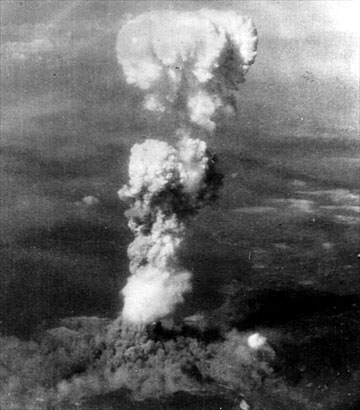 At 8:15 am on August 6th 1945 the Enola Gay dropped “Little Boy” the first nuclear weapon to be used in an act of war. Hiroshima was obliterated. It is estimated that 100,000 to 150,000 died instantly, being evaporated by the nuclear blast. In the years to follow at least another 50,000 to 100,000 died from radiation poisoning and the effects of the blast. Nine days later the Emperor of Japan surrendered and World War II was over.
Personally, I wrestle back and forth over whether this bombing was justified. Thousands were dying in WWII and an invasion of the Japanese mainland most likely would have brought hundreds of thousands of more deaths. Yet, does the end of the war justify the means used to end it? Is Hiroshima and Nagasaki justified in the lives that were saved? This is the paradox of the atomic weapon. In destroying countless lives, countless others were saved.
Regardless of whether one sees the bombing of Hiroshima and Nagasaki as wrong or not, as Christians we must always remember them. We must remember the lives that were lost and we must remember the lives that were saved. Most importantly we must see this event as a reflection of the sinfulness of humanity. Hiroshima is a logical outworking of our wretched condition. Apart from Christ, life is hell. Without a Savior those who are facing eternal damnation will face an eternity of Hiroshimas infinitely worse than anything imaginable. Yet, for those who put their faith and trust in Jesus Christ there is hope even in Hiroshima. Christ is to be found in the despair of this life. And because of his coming into this world there is now hope and life for those who believe.
The message of Hiroshima is one of sin and misery. But the good news of Jesus Christ is that within that sin and misery there is hope and life, even in the midst of Hiroshima.
Friday, August 05, 2005
Baptist Covenant Theology Conference
Founder's Ministries will sponsor an upcoming conference on Baptist Covenant Theology. The Southern Baptist Founder's Conference Southwest will be held from September 22-24, 2005 at Heritage Baptist Church in Mansfield, TX. The two main speakers will be Dr. Fred Malone and Dr. Jim Renihan. Here are some of the topics (click here for the schedule):
The Hermeneutics of Baptist Covenant Theology
Our Covenant-Keeping God
The Founders of the SBC and Covenant Theology
The New Covenant
Baptism
This should be a wonderful conference. Of course, I will not be able to attend, but I look forward to listening to the tapes.
The Destroyer of Worlds
Tomorrow - August 6th 2005 marks the 60th anniversary of the bombing of Hiroshima. Below is a review I wrote of Martin J. Sherwin's A World Destroyed: Hiroshima and its Legacies.
The atomic bombings of Hiroshima and Nagasaki forever changed the world landscape. The Nuclear Age came to be and a new god arose out of the ashes. The atomic bomb and nuclearism (the worshipful embrace of atomic weapons) came to rule the world in the vacancy left by the Second World War. The bomb and atomic energy came to be viewed as deity because in the words of Robert J. Lifton, "what other than a deity could be capable of destroying the world?" "But a deity also must be capable of ruling and protecting the world, even of keeping the world going?" (From the foreword). The bomb was embraced with both fear and wonder as that of a deity capable of both governing and destroying the world in a single action.It is this deity's rise to power, which is here chronicled by Martin J. Sherwin. The complex political history is detailed from the beginnings of the Manhattan Project to the destruction of both Hiroshima and Nagasaki. Offering a fair treatment of all involved Sherwin provides the political backdrop to the creation of the atomic legacy, which continues to this day.
In this work he deals with the scientists' struggles with the military and subsequent use of their work toward military ends. These "soldiers out of uniform" began the race for the atomic bomb against Germany yet towards the end of their work many became increasingly aware of the moral ramifications for unleashing such a devastating device upon humanity. The burning question which continually came up to both scientists, political advisors and the world leaders involved (FDR, Truman, and Churchill) was, "What role would the atomic bomb take in the postwar world?" This question often failed to illicit response and only came to its answer after the destruction of both Hiroshima and Nagasaki.
Sherwin spends much time on the relationship of the Soviet Union (Stalin) to the bomb. In the end the choice was to not let the Soviets in on the secret of S-1 (the military designation of the bomb) and Sherwin highlights how many saw this as negatively affecting the postwar relationship between an already fragile wartime cooperation between England, the United States and the Soviet Union. While Truman sought to use the bomb as leverage (at the Potsdam Conference) against both the Japanese and the Russians it seems to have worked for the Japanese but failed for the Russians. Japan surrendered shortly after the bombing of two of its cities, but the Soviet Union became hardened to the U.S. and American-Soviet relations quickly deteriorated. Could the Cold War have been averted if Roosevelt and Truman only included Stalin in on the knowledge of the bomb?
The atomic bomb brought about the end of the Second World War but brought about the beginning of the arms race and new war of nuclearism. While it was meant to be a means of peace during the war, the atomic bomb became a means of clouding the future of the postwar world. In conclusion, Sherwin quotes Henry Adams whom a century before the bomb wrote, "Man has mounted science, and is now run away with."
This book provides an immensely helpful pathway into the politics surrounding the creation and use of the atomic bomb. Unfortunately the scientific dimension of the creation and use of the bomb is lacking. Nonetheless this book is useful for understanding the political climate of the time and for also setting the backdrop to the Cold War and future American-Soviet relations. It is a good read, which would have been enhanced with some pictures of the key players, maps of the important places, and photographs (carefully chosen) of the subsequent devastation of the bomb.
While the political ramifications were effectively highlighted and questioned the moral issues while often raised were not adequately dealt with. While this is not a book on ethics it would have been interesting to explore the ethical legacies left from the bombing of Hiroshima and Nagasaki. Sherwin does note that the majority of the political leaders never thought twice about using the bomb against Japan. I do not recall Sherwin connecting this at all with Pearl Harbor and I wonder what connection (if any) existed between the bombing of Pearl Harbor and the unquestioned use of the atomic bomb against Japan. It would have been worthwhile to explore further the ethical/moral impact, which the bomb had on the world and world leaders. Not much is dealt with after the bombing and because of that I was left somewhat disappointed.
Overall this is an excellent work, which details the political backdrop and milieu of the creation and use of the atomic bomb. It raises important political questions, which need answers. It unfortunately does not raise moral issues as such a topic should, but then again the purpose of the book was to show the political events surrounding the bomb. Nonetheless one wonders if the political arena and the moral arena can be separated. What is clear is that a new deity was created and released, one that continues to govern this world and strike fear in the hearts of nations, one with the power to destroy the world.
Wednesday, August 03, 2005
Total Depravity in the News
I often tell others that the best way to teach about Total Depravity is to read or watch the news. It is impossible to go away from the average news cast thinking that people are morally good.
A 27 year old man was shot and killed in an apparent act of road rage. He was taking his 10 month old daughter out of her carseat when he was gunned down. Thankfully the child was unharmed, physically...
And then CNN reports a deathly discovery of a few hundred bodies of babies stored in jars in a hospital in Paris. France has a law that a child's body must be cremated within 10 days after the child's death. Dr. Pierre-Marie Cousin, president of the union of gynecologists and obstetricians, said, "The fact that the burial or cremation of these stillborn babies wasn't carried out is perhaps negligence, but not a moral problem." Not a moral problem!!! What!?!
Our world is deathly sick and desperately in need of THE Savior.
Complete Founder's Response to Lemke & Welch
I wanted to bring all of the material written by Tom Ascol in response to Steve Lemke together under one post. So here it is:
First Response Second Response Third Response Final Observations Response to Lemke's LetterI am not so sure if all the issues were cleared up, but I do appreciatte the spirit of the dialog. The debate over Calvinism is a debate within Christianity. We must remember that we are challenging brothers and sisters in Christ. Such argumentation must be done in a spirit of humility and graciousness. A few quotes from Ascol:
The leadership of the Southern Baptist Convention should recognize that many churches and pastors--especially younger pastors--in the convention are growing very weary of the lack of authenticity that comes through in their touting of numbers, largeness and programs. It smacks of triumphalism and a growing number are finding it increasingly off-putting. If SBC leadership wants everyone to jump up and down about the prospect of baptizing a million people in the next 12 months, then first convince us that you are willing to speak honestly about the ten million who have already been baptized but rarely, if ever, even show up on a Sunday morning in our churches.As a young potential pastor this quote is dead on. I often become very discouraged with the SBC's insistence on numbers and the doctrinal childishness so often played out by its leaders.
The bloated statistics of the SBC are a veneer that conceals serious doctrinal and spiritual problems. It is time for Southern Baptists to drop the facade and to confront the problems directly, with humility and submission to the Word of God. This is not a Calvinist issue. This is a Christian and Baptist issue.Again, it is a number problem! Regenerate church membership must be recovered. Thank you Tom Ascol for your work in continually defending the doctrines of grace against this barrage of silliness.
Tuesday, August 02, 2005
Called to Monasticism?
Still searching for the answers to life? Are you struggling to fill an empty void within? Do you want more to this life than what you currently have? Do you have purpose and meaning? Maybe you are called to be a monk.
The monks of Portsmouth Abbey have found answers to these questions in the Rule of St. Benedict… Could this be the answer for you? We invite you to experience a week of prayer, work, rest, and recreation in our Monastic Life Experience Program for single, college educated, Catholic men, 21-45 years old, who wish to spend some time considering a call to monastic life. This call may be for you! See http://www.portsmouthabbey.org/ for more information.Even monks have a try before you buy program…
Monday, August 01, 2005
Scripture and the Public School System
I always have found the debate over religion and the public school system as doomed from the beginning. It does not seem that it is a battle, which Christians are capable of winning, let alone a battle that Christians should even be fighting. Yet, the battle continues and I am afraid that if any religious tolerance is granted it will only allow a watered down and meaningless presentation of the Christian faith.
There is now raging a debate in Odessa, TX over the use of a Bible study course curriculum. The curriculum is developed and promoted by the National Council on Bible Curriculum in Public Schools. The following is posted on the Councils website:
The curriculum for the program shows a concern to convey the content of the Bible as compared to literature and history. The program is concerned with education rather than indoctrination of students. The central approach of the class is simply to study the Bible as a foundation document of society, and that approach is altogether appropriate in a comprehensive program of secular education.
A few thoughts: First, the Bible cannot be compared to other great books of literature and history. If it is relegated to a mere historical or literary book than the message of the Bible is dead. Rather, the Bible is the book of life or judgment to those who accept or reject its message. Secondly, the claims of objectivity are just downright impossible. Just what is the fine line between education and indoctrination? The public school system fails to realize that they do more than just simply provide objective education. The entire system indoctrinates. Whether they realize it or not they are brainwashing children with their own religion – secular humanism. This battle is not one of religion verses objective education, but one of two religious worldviews clashing against each other. Lastly, if the approach to studying the Bible is “appropriate in a comprehensive program of secular education” then it can be nothing more than a gospel-less, watered down message of the Way, the Truth, and the Life.
I for one certainly don’t want this kind of curriculum in the public school system. Once the Bible is made into another book of history or literature taught appropriately for the public school system than its message is already lost.
Sunday, July 31, 2005
Fatwa Against Terrorism
On July 28th the Fiqh Council of North America issued a religious declaration against Islamic terrorism. Here is the fatwa in its completeness:
The Fiqh Council of North America wishes to reaffirm Islam's absolute condemnation of terrorism and religious extremism.
Islam strictly condemns religious extremism and the use of violence against innocent lives. There is no justification in Islam for extremism or terrorism. Targeting civilians’ life and property through suicide bombings or any other method of attack is haram – or forbidden - and those who commit these barbaric acts are criminals, not “martyrs.”
The Qur’an, Islam’s revealed text, states: "Whoever kills a person [unjustly]…it is as though he has killed all mankind. And whoever saves a life, it is as though he had saved all mankind." ( Qur’an, 5:32 )
Prophet Muhammad said there is no excuse for committing unjust acts: "Do not be people without minds of your own, saying that if others treat you well you will treat them well, and that if they do wrong you will do wrong to them. Instead, accustom yourselves to do good if people do good and not to do wrong (even) if they do evil." (Al- Tirmidhi)
God mandates moderation in faith and in all aspects of life when He states in the Qur’an: “We made you to be a community of the middle way, so that (with the example of your lives) you might bear witness to the truth before all mankind.” ( Qur’an, 2:143)
In another verse, God explains our duties as human beings when he says: “Let there arise from among you a band of people who invite to righteousness, and enjoin good and forbid evil.” ( Qur’an, 3:104)
Islam teaches us to act in a caring manner to all of God's creation. The Prophet Muhammad, who is described in the Qur’an as “a mercy to the worlds” said: “All creation is the family of God, and the person most beloved by God (is the one) who is kind and caring toward His family."
In the light of the teachings of the Qur’an and Sunnah we clearly and strongly state:
1. All acts of terrorism targeting civilians are haram (forbidden) in Islam.
2. It is haram for a Muslim to cooperate with any individual or group that is involved in any act of terrorism or violence.
3. It is the civic and religious duty of Muslims to cooperate with law enforcement authorities to protect the lives of all civilians.
We issue this fatwa following the guidance of our scripture, the Qur’an, and the teachings of our Prophet Muhammad – peace be upon him. We urge all people to resolve all conflicts in just and peaceful manners.
We pray for the defeat of extremism and terrorism. We pray for the safety and security of our country, the United States, and its people. We pray for the safety and security of all inhabitants of our planet. We pray that interfaith harmony and cooperation prevail both in the United States and all around the globe.
While the fatwa used a few verses to condemn Islamic terrorism it failed to address the countless verses within the Qur’an, which encourage and command such violence. The fatwa states, “there is no justification in Islam for extremism or terrorism.” Yet, there is overwhelming documentation, which lists 164 verses of Jihad, or Jihad related themes in the Qur’an. How will Muslims answer these verses? Will Muslims across the world embrace this fatwa? Will only “secular or westernized” Muslims accept it? This may be a small step in the right direction, but if Western Muslims want to clean up their image they have a long way to go. Every suicide bomber, every terrorist act – in the name of Islam – only further adds weight to the Qur’anic interpretation held by those supposed “radical Muslims.” Maybe they are not as radical as we think. Maybe they are only seeking to understand the Qur’an at face value within their socio-historical context. Maybe the Muslims of the west are watered down versions of what True Islam really is. Yet, the most important question is this: whose interpretation of the Qur’an is correct? If the Qur’an is the rule and authority for all Muslims, who is a more faithful interpreter? Secular western Muslims or radical Islamic Terrorists?Saturday, July 30, 2005
Questions to Ask Prospective Churches
I am looking to find a pastorate where I can serve the people of God through the ministry. In the candidating process wise churches will always take time to drill their potential pastor to find the best candidate for their church. Yet, potential pastors must also ask hard and good questions about the church. I have begun writing a list of questions and I am wondering what else should be added. Any suggestions would be greatly appreciated.
- What are you looking for in a pastor?
- What is the most important thing a pastor can do for you personally? For the church?
- What can the pastor do to get to know the members of the church?
- What do you believe are the duties of the pastor?
- What do you believe are the duties of the pastor’s wife? Namely, does she have to be involved at every church event?
- What type of preaching does your church prefer? Examples?
- How long do you expect sermons to last?
- What type of music styles does your church prefer?
- Is your church more traditional (hymns) or contemporary (choruses) or both?
- Have there been any church splits or acts of church discipline within the recent past?
- How lethargic or passionate would you say the congregation as a whole is?
- If lethargic what steps do you believe the church needs to take to become more passionate? If passionate or somewhere in between what does the church need to do to keep the fire going and to stoke it further?
- What is the purpose and mission of the church?
- How do you want your church to grow? In what specific and tangible ways can this growth be achieved?
- In five years what should be different with your church?
- How do you feel about the pastor’s continual education? How will this be supported?
- How will the church help support the sanctity of the pastor’s home? I.e. how will the church help provide time alone for the pastor and his family without interruption?
- What are you doing now to evangelize your community? What can be done differently and how would you like to move forward?
- What are your thoughts on the pastor and his family making regular visits to your home to spend with your family? Do you think this is important?
- What are the pressing needs of the church, both spiritually and materially? What are the things that need to be prayed for the most?
Sex & Soccer
Berlin, Germany – To keep sex off the streets the Germans have begun construction on a new mega-brothel. It has been dubbed “The Artemis Project” after the Greek virgin goddess Artemis. The brothel complex opens this September complete with a “whirlpool, sauna, cinema, buffet restaurant and a staff of 100 prostitutes.” Prostitution is legal in certain parts of Germany.
Why go to such an effort to develop this mega-brothel? Well, it is located only a brief walk away from Berlin’s Olympic Stadium, which will host next year’s Soccer World Cup. Soccer fans after all need their sex. With the great influx of people to the area Germany wants to be prepared. It seems that their building of this brothel has behind it the noble intentions of keeping prostitution off the streets.
Now the thousands of sexual soccer fans can enjoy their whoredom in the comfort of Berlin’s finest living. No longer will sex need to be performed in the dingy back seat of a car. In today’s modern Germany it can be enjoyed with all the comforts of home – a whirlpool, sauna, movie theatre, buffet restaurant, and oh yeah – 100 prostitutes!
It’s good that the Germans want to make sex safer by bringing it in doors. After all we wouldn’t want the prostitutes and their clientele to be exposed to the elements and the dirty back seats of sexual perversity.
Wednesday, July 27, 2005
Founder's Response Part 1
Tom Ascol of Founders Ministries has begun his response to Bobby Welch's article based on Steve Lemke's writing titled, "The Future of Southern Baptists as Evangelicals."
Here is my favorite quote:
I keep waiting for some Southern Baptist leader to stand up and declare honestly to the world that our denominational statistics are in many respects a sham, a lie and false advertizing. We are not "16 million strong." The FBI could not find half of them if we put them on the most wanted list. Take Brother Bobby's church, which is above average, for example. According to their website, their total membership is 4000 and average attendance is 2000 (I assume this latter number reflects the Sunday morning worship attendance and not the Wednesday night prayer meeting attendance). The typical Southern Baptist church has less than 40% of its total membership in attendance on any given Sunday MORNING.
Tuesday, July 26, 2005
Calvinism, the SBC, and Evangelism
In the recent edition of Reminder (the newsletter of the First Baptist Church of Daytona Beach, FL) Bobby Welch, president of the Southern Baptist Convention, raised the question as to the extent Calvinism has negatively influenced evangelism within the SBC. He cited Steve Lemke’s (Provost at New Orleans Baptist Theological Seminary) article entitled, “The Future of Southern Baptists as Evangelicals.”
It seems that the biggest concern of Welch is that Calvinist leaning churches have fewer baptisms than the “typical” Southern Baptist church. He cites Lemke’s research: “Their (Founder’s Friendly Calvinist churches) baptism to member ration was 1:62; it was 1:42 in the rest of the Southern Baptist Convention.” This statistic must be appalling for someone who is driving around in a bus seeking One Million Baptisms.
Just a few thoughts for now:
- Lemke, and therefore Welch, both confuse Hyper-Calvinism (Hard-Calvinism) with regular good old-fashioned Dortian Calvinism. It is all too common for anti-Calvinists to conflate and confuse Calvinism with Hyper-Calvinism. It must be stated unequivocally – hyper-Calvinism is heresy plain and simple. It distorts the gospel of grace and removes human responsibility from the picture of salvation. I will agree with them that hyper-Calvinism does destroy evangelism and missions. However, Calvinism (all five points) rightly understood provides the foundation, hope and basis for missions and evangelism (I hope to address this more in a later post). True, biblical Calvinism upholds both God’s sovereignty and man’s responsibility in a tension of beautiful mystery.
- Welch and Lemke level their sights at Founder’s ministries – a ministry within the SBC calling churches back to the Reformed / Calvinist heritage. It is common historical knowledge that the founders of the SBC were Reformed Calvinists.
- With all statistics there is always interpretation and after reading Lemke I am left wondering how much interpreting of the numbers he has done. Lemke writes, “Founder’s Fellowship churches had considerably fewer baptisms, smaller congregations, more declining membership than the average Southern Baptist Church.”
- First, fewer baptisms – well there is a simple answer. Most Calvinists at the very least are nervous about Welch’s One Million Baptisms and more so are down right saddened by its unbiblical emphasis. Welch is focusing on baptism to the exclusion of discipleship. The two must go together. Maybe he should promote One Million Baptized Disciples. I personally would be happier with that approach. Calvinists weigh heavily and thoughtfully one’s decision to be baptized. All too often Southern Baptists churches line up their people in a dunking booth-assembly line fashion just to obtain their numbers. This is a sad blight upon the Convention.
- Smaller Congregations. Well, no wonder – how would you fare if the president of the Southern Baptist Convention personally attacked you with poor and confused information all the while arguing that you do not evangelize. Let’s face it Calvinism gets a bad rap. Is some of it justified? Maybe, but not to the extent Welch and Lemke want to take it. Plus we need to remember that Founder’s is a new resurgence within the SBC. Do you think they should have the most churches if they only started a few decades ago and have to penetrate the entire convention all the while being painted with false caricatures?
- Lastly, there is the statistic that 79% of Founder’s churches have plateaued or are declining. Unfortunately, there is just no information presented but a bare stat to back this claim up. I am curious to discover how they reached this percentage. Just one thought: maybe it is because Calvinist churches have sought to clean up their church membership rolls in order to seek after the biblical doctrine of regenerate church membership. Just a thought…
The thing that bothers me most about such ignorant claims is that the majority of people who read such confusion will believe it. I do believe, however, that the greater burden should be on Calvinists. We need to defend our doctrine with our lifestyle. Let us use this as a call to bring about a more God-centered evangelism, more Christ-focused missions and more Spirit-let churches.
I hope to deal with Lemke’s article in a future post. (HT: Thanks Scott)
Monday, July 25, 2005
Reformation 21
The Alliance of Confessing Evangelicals has just begun a new online journal called Reformation 21. The inaugural issue begins with discussing the controversial New Perspective on Paul. Ligon Duncan kicks off the issue with "Do we need a New Perspective on Paul." Richard Phillips also has a three part series, which looks at "The New Perspective on Justification." He begins by looking at the history and development of the New Perspective on Paul (NPP). Then he evaluates NPP's understanding of justification closing it off with a case study on the imputation of Christ's righteousness.
Reformation 21 also offers book reviews, a blog and a section titled Counterpoint which deals with culture and seeks to apply biblical principles to this world. Reformation 21 is edited by Derek Thomas and will have contributions from J. Ligon Duncan, Carl Trueman, Phil Ryken, Richard Phillips and others.
This should prove to be an excellent resource to fulfill the mission of the Alliance of Confessing Evangelicals (a mission which I wholly endorse):
The Alliance of Confessing Evangelicals exists to call the twenty-first century church to a reformation that recovers clarity and conviction about the great evangelical truths of the gospel and that then seeks to proclaim these truths powerfully in our contemporary context.(HT: Between Two Worlds)
Restorative Justice
Charles Colson has become a leading voice within evangelicalism and it took prison to transform him. Through the Watergate scandal and his seven-month stint behind bars Colson came to realize the futility of the prison system and the futility of his own heart apart from Christ his maker. In the mystery of divine providence it took justice to bring about restoration. Colson, now redeemed by Christ, is seeking to also bring redemption and restorative justice to the nation’s prison systems.
Adam Cohen, writing today in the NY Times (free account required), argues that his mission began with Watergate. Cohen is more surprised in Colson becoming a “radical prison reformer” than in becoming a conservative Christian. He writes, “Political conservatives have traditionally been more focused on punishing criminals than on reforming them, and religious conservatives have generally felt the same way.” Cohen sees liberal institutions as being at the forefront of prison reform, not conservative evangelical organizations.
He quotes Colson to that end, “The evangelical church has some great strengths," Mr. Colson said in an interview, but historically, "concern for the poor and the marginal was not one of them." Cohen correctly highlights two reasons why Colson seeks prison reform. First, it is because Colson is intimately aware of the prison system. He has spent time there and he continues to spend most of his life through ministering within the walls of prisons. Secondly, and more importantly, Colson believes that the driving force behind his reform is the biblical injunction of dealing with offenders through redemption. Only Christ can change an inmate’s heart and transform their life into something meaningful.
Colson is right – justice must be restorative. The end of justice is redemption. Yet, sadly as Colson notes, the evangelical church has failed miserably in seeking redemption for offenders, for the needy and the poor. Yet James exhorts us, “Religion that is pure and undefiled before God, the Father, is this: to visit orphans and widows in their affliction, and to keep oneself unstained from the world” (1:27).
One of the things I appreciate most about Charles Colson and Prison Fellowship is the Angel Tree project. Every year, around Christmas, they collect gifts for the children of prison inmates. It is a small, but meaningful way of “visiting orphans and widows in their affliction.” Some years ago we took part in the Angel Tree program and even had the opportunity to spend time with those children. We took them to our church gym and ran around with them playing and just having fun. They immediately clung to you, as their need for a father figure was apparent. It brought both joy and sadness to my heart at the same time. Even in this small way – giving gifts to needy children – redemption was worked out in the midst of justice.
The cross of our Lord is no different. The justice of God was satisfied as Christ suffered for our sin upon that rugged tree. Yet through his suffering we were granted redemption. It is my hope and prayer that many within the prison system, along with their families, will find redemption in justice. Charles Colson knows well that offenders can be redeemed. Those who meet justice can be restored.
Sunday, July 24, 2005
theologia viatorum
theologia viatorum: theology of the viatores, or pilgrims; a term applied to the incomplete or imperfect theology of believers in the world, in contrast to the theology of those who have reached their end in God, the theologia beatorum (Richard A. Muller, Dictionary of Latin and Greek Theological Terms: Drawn Principally from Protestant Scholastic Theology. Grand Rapids, MI: Baker Books, 1985.)
Theology is a journey. It is a pilgrimage with a goal in sight: theologia beatorum – theology of the blessed. The theology of the blessed is a theology granted in heaven of a deeper, clearer, and fuller knowledge of God and his Christ. It is the perfected form of human theology. It is a theology, which Christian pilgrims strive for while on earth. It is a “theology of earthly pilgrims or wanderers searching for the heavenly city” (Muller, theologia beatorum).
It will only be obtained at the end of the journey. Once the pilgrim passes through the black river of death only then will he enter into the celestial city. Until that time the Christian wanderer is a theological pilgrim.
However, this is no wandering like the Israelites in the desert for forty years. They marched in circles year after year, but a theological pilgrim is one who, although wandering, continues to grow in the grace and knowledge of the Lord Jesus Christ. It is not endless wandering. With God there is always progression.
The road traveled is one of purpose. There is a destination. As the pilgrim ventures further and further along this life so he walks closer and closer to theological truth. As Scripture becomes all the more embedded into his person so the pilgrim comes closer to Christ. Knowing Christ is the goal of this life. To know the way and the truth and the life is our end. It is a life of joy, but a life of the cross. It is a life of persecution, but also a life of hope. It is a life of law, but also a life of gospel. It is a life journeyed toward the city of our God.
The Christian life is lived out down the road less traveled. But on that road we travel not alone. The theological pilgrim wanders down this Emmaus road, walking side by side with Christ. At times the path is overgrown and the way unclear. Yet, the way is always forward, dim though it may be. It is on this road where hearts are lit afire for the Lord Jesus Christ and his gospel of salvation. It is down this path where we will find our final resting place, where we will reach the city of God and entered into his eternal rest. This is the way of theologia viatorum; this is the path of pilgrim theology.
Subscribe to:
Posts (Atom)

